Visualizzazione post con etichetta Future. Mostra tutti i post

venerdì 7 novembre 2014

The Green Future of Aerospace Construction & Maintenance

Steven F. Udvar-Hazy Center: Space Shuttle Enterprise in the James McDonnell Space Hangar
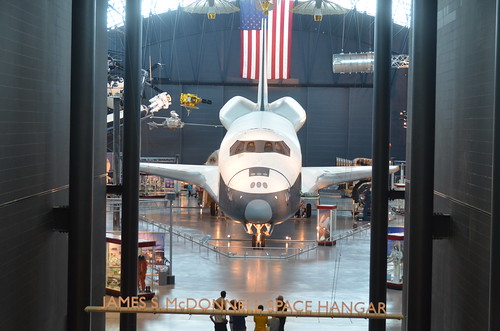
aerospace e defense focus_keyword 5779409164 a848f814c8

Image by Chris Devers
See more photos of this, and the Wikipedia article.


Details, quoting from Smithsonian National Air and Space Museum | Space Shuttle Enterprise:


Manufacturer:
Rockwell International Corporation


Country of Origin:

United States of America


Dimensions:

Overall: 57 ft. tall x 122 ft. long x 78 ft. wing span, 150,000 lb.

(1737.36 x 3718.57 x 2377.44cm, 68039.6kg)


Materials:

Aluminum airframe and body with some fiberglass features; payload bay doors are graphite epoxy composite; thermal tiles are simulated (polyurethane foam) except for test samples of actual tiles and thermal blankets.


The first Space Shuttle orbiter, "Enterprise," is a full-scale test vehicle used for flights in the atmosphere and tests on the ground; it is not equipped for spaceflight. Although the airframe and flight control elements are like those of the Shuttles flown in space, this vehicle has no propulsion system and only simulated thermal tiles because these features were not needed for atmospheric and ground tests. "Enterprise" was rolled out at Rockwell International’s assembly facility in Palmdale, California, in 1976. In 1977, it entered service for a nine-month-long approach-and-landing test flight program. Thereafter it was used for vibration tests and fit checks at NASA centers, and it also appeared in the 1983 Paris Air Show and the 1984 World’s Fair in New Orleans. In 1985, NASA transferred "Enterprise" to the Smithsonian Institution’s National Air and Space Museum.


Transferred from National Aeronautics and Space Administration


• • •


Quoting from Wikipedia | Space Shuttle Enterprise:


The Space Shuttle Enterprise (NASA Orbiter Vehicle Designation: OV-101) was the first Space Shuttle orbiter. It was built for NASA as part of the Space Shuttle program to perform test flights in the atmosphere. It was constructed without engines or a functional heat shield, and was therefore not capable of spaceflight.


Originally, Enterprise had been intended to be refitted for orbital flight, which would have made it the second space shuttle to fly after Columbia. However, during the construction of Columbia, details of the final design changed, particularly with regard to the weight of the fuselage and wings. Refitting Enterprise for spaceflight would have involved dismantling the orbiter and returning the sections to subcontractors across the country. As this was an expensive proposition, it was determined to be less costly to build Challenger around a body frame (STA-099) that had been created as a test article. Similarly, Enterprise was considered for refit to replace Challenger after the latter was destroyed, but Endeavour was built from structural spares instead.


Service


Construction began on the first orbiter on June 4, 1974. Designated OV-101, it was originally planned to be named Constitution and unveiled on Constitution Day, September 17, 1976. A write-in campaign by Trekkies to President Gerald Ford asked that the orbiter be named after the Starship Enterprise, featured on the television show Star Trek. Although Ford did not mention the campaign, the president—who during World War II had served on the aircraft carrier USS Monterey (CVL-26) that served with USS Enterprise (CV-6)—said that he was "partial to the name" and overrode NASA officials.


The design of OV-101 was not the same as that planned for OV-102, the first flight model; the tail was constructed differently, and it did not have the interfaces to mount OMS pods. A large number of subsystems—ranging from main engines to radar equipment—were not installed on this vehicle, but the capacity to add them in the future was retained. Instead of a thermal protection system, its surface was primarily fiberglass.


In mid-1976, the orbiter was used for ground vibration tests, allowing engineers to compare data from an actual flight vehicle with theoretical models.


On September 17, 1976, Enterprise was rolled out of Rockwell’s plant at Palmdale, California. In recognition of its fictional namesake, Star Trek creator Gene Roddenberry and most of the principal cast of the original series of Star Trek were on hand at the dedication ceremony.


Approach and landing tests (ALT)


Main article: Approach and Landing Tests


On January 31, 1977, it was taken by road to Dryden Flight Research Center at Edwards Air Force Base, to begin operational testing.


While at NASA Dryden, Enterprise was used by NASA for a variety of ground and flight tests intended to validate aspects of the shuttle program. The initial nine-month testing period was referred to by the acronym ALT, for "Approach and Landing Test". These tests included a maiden "flight" on February 18, 1977 atop a Boeing 747 Shuttle Carrier Aircraft (SCA) to measure structural loads and ground handling and braking characteristics of the mated system. Ground tests of all orbiter subsystems were carried out to verify functionality prior to atmospheric flight.


The mated Enterprise/SCA combination was then subjected to five test flights with Enterprise unmanned and unactivated. The purpose of these test flights was to measure the flight characteristics of the mated combination. These tests were followed with three test flights with Enterprise manned to test the shuttle flight control systems.


Enterprise underwent five free flights where the craft separated from the SCA and was landed under astronaut control. These tests verified the flight characteristics of the orbiter design and were carried out under several aerodynamic and weight configurations. On the fifth and final glider flight, pilot-induced oscillation problems were revealed, which had to be addressed before the first orbital launch occurred.


On August 12, 1977, the space shuttle Enterprise flew on its own for the first time.


Preparation for STS-1


Following the ALT program, Enterprise was ferried among several NASA facilities to configure the craft for vibration testing. In June 1979, it was mated with an external tank and solid rocket boosters (known as a boilerplate configuration) and tested in a launch configuration at Kennedy Space Center Launch Pad 39A.


Retirement


With the completion of critical testing, Enterprise was partially disassembled to allow certain components to be reused in other shuttles, then underwent an international tour visiting France, Germany, Italy, the United Kingdom, Canada, and the U.S. states of California, Alabama, and Louisiana (during the 1984 Louisiana World Exposition). It was also used to fit-check the never-used shuttle launch pad at Vandenberg AFB, California. Finally, on November 18, 1985, Enterprise was ferried to Washington, D.C., where it became property of the Smithsonian Institution.


Post-Challenger


After the Challenger disaster, NASA considered using Enterprise as a replacement. However refitting the shuttle with all of the necessary equipment needed for it to be used in space was considered, but instead it was decided to use spares constructed at the same time as Discovery and Atlantis to build Endeavour.


Post-Columbia


In 2003, after the breakup of Columbia during re-entry, the Columbia Accident Investigation Board conducted tests at Southwest Research Institute, which used an air gun to shoot foam blocks of similar size, mass and speed to that which struck Columbia at a test structure which mechanically replicated the orbiter wing leading edge. They removed a fiberglass panel from Enterprise’s wing to perform analysis of the material and attached it to the test structure, then shot a foam block at it. While the panel was not broken as a result of the test, the impact was enough to permanently deform a seal. As the reinforced carbon-carbon (RCC) panel on Columbia was 2.5 times weaker, this suggested that the RCC leading edge would have been shattered. Additional tests on the fiberglass were canceled in order not to risk damaging the test apparatus, and a panel from Discovery was tested to determine the effects of the foam on a similarly-aged RCC leading edge. On July 7, 2003, a foam impact test created a hole 41 cm by 42.5 cm (16.1 inches by 16.7 inches) in the protective RCC panel. The tests clearly demonstrated that a foam impact of the type Columbia sustained could seriously breach the protective RCC panels on the wing leading edge.


The board determined that the probable cause of the accident was that the foam impact caused a breach of a reinforced carbon-carbon panel along the leading edge of Columbia’s left wing, allowing hot gases generated during re-entry to enter the wing and cause structural collapse. This caused Columbia to spin out of control, breaking up with the loss of the entire crew.


Museum exhibit


Enterprise was stored at the Smithsonian’s hangar at Washington Dulles International Airport before it was restored and moved to the newly built Smithsonian’s National Air and Space Museum‘s Steven F. Udvar-Hazy Center at Dulles International Airport, where it has been the centerpiece of the space collection. On April 12, 2011, NASA announced that Space Shuttle Discovery, the most traveled orbiter in the fleet, will be added to the collection once the Shuttle fleet is retired. When that happens, Enterprise will be moved to the Intrepid Sea-Air-Space Museum in New York City, to a newly constructed hangar adjacent to the museum. In preparation for the anticipated relocation, engineers evaluated the vehicle in early 2010 and determined that it was safe to fly on the Shuttle Carrier Aircraft once again.


No industry on the planet uses more solvents, degreasers and phenyl compounds per unit of sale than the aerospace industry, where the high tolerances required on both mechanical and electrical parts puts a premium on cleanliness and non-conductivity of the cleaning material used.


For going on sixty years, if it was used on a jet engine, it was probably cleaned with trichloroethane 1,1,1, a compound that acted as a solvent, was heavier than air (making it ideal for use in several applications), was non-conductive and had a vapor point that was high enough to be a fire retardant. Unfortunately, trichloroethane is also a chlorofluorocarbon, and it’s used was mandated to be phased out by compliance with the Montreal accords.


The Montreal accords banning CFCs are mostly known for changing refrigerants, but they also ended up mandating changes to a lot of industrial solvents. Aerospace companies are going to have to find replacement chemical solvents that will both get the job done in an efficient manner, and not cost much more than the chemicals they replace. This latter is a significant barrier to entry, because the reasons why the existing solvents are in use is because they’re cheap to get at, most chemical plants could make them from feed stocks at hand, and are royalty and patent free. This allows for significant economy of scale in their production and shipping.


Many of the newer organic solvents are still being put through phase trials, and some of them require mixed solutions -where multiple jobs could be done with a single older chemical solvent, the newer chemical solvents tend to be much more specialized in their applications and the jobs they can be used for. This means that you’ll need smaller quantities of different solvents and reagents on hand.


All that said, the savings these materials offer is on the disposal side of things. As a general rule, they’re easier to work with and safer for your staff to handle; they don’t require quite as rigorous a set of safety gear, and they’re much less hazardous to handle in general. And, as they become more wide spread, the costs will drop – and the fines for use of the older materials will go up.


The future of aerospace work in construction, engine rebuilding and maintenance is going to be dominated by these organic solvents and degreasers; the sooner you adapt your work flow to them, the greater your total benefit is going to be.


More and more businesses are doing what ever it takes by using environmentally safe products such as Organic Degreasers. One of the best places to start is ecolink.com. Ecolink has helped a long list of leading manufacturers, aerospace companies, energy utilities, transportation providers, the military and government organizations navigate unpredictable industrial chemical bans and phase-outs by promoting Less Chemicals and Safer Chemicals. The are a leading authority on Organic Solvents.




Online Co-op Mission Su-35 (Level 2) 6AAM (Level 1) 4 Players (first part) Kenshin0x08 vs BDZ-EX200 FATE-SABER006.
Video Rating: 0 / 5


The Green Future of Aerospace Construction & Maintenance

mercoledì 5 novembre 2014

Opportunities & Future in Aviation & Aerospace Industry

Steven F. Udvar-Hazy Center: View of south hangar, including B-29 Superfortress “Enola Gay”, a glimpse of the Air France Concorde, and many others
aerospace e defense focus_keyword 5778921340 1ce394232f

Image by Chris Devers

Quoting Smithsonian National Air and Space Museum | Boeing B-29 Superfortress "Enola Gay":


Boeing’s B-29 Superfortress was the most sophisticated propeller-driven bomber of World War II and the first bomber to house its crew in pressurized compartments. Although designed to fight in the European theater, the B-29 found its niche on the other side of the globe. In the Pacific, B-29s delivered a variety of aerial weapons: conventional bombs, incendiary bombs, mines, and two nuclear weapons.


On August 6, 1945, this Martin-built B-29-45-MO dropped the first atomic weapon used in combat on Hiroshima, Japan. Three days later, Bockscar (on display at the U.S. Air Force Museum near Dayton, Ohio) dropped a second atomic bomb on Nagasaki, Japan. Enola Gay flew as the advance weather reconnaissance aircraft that day. A third B-29, The Great Artiste, flew as an observation aircraft on both missions.


Transferred from the United States Air Force.


Manufacturer:
Boeing Aircraft Co.
Martin Co., Omaha, Nebr.


Date:

1945


Country of Origin:

United States of America


Dimensions:

Overall: 900 x 3020cm, 32580kg, 4300cm (29ft 6 5/16in. x 99ft 1in., 71825.9lb., 141ft 15/16in.)


Materials:

Polished overall aluminum finish


Physical Description:

Four-engine heavy bomber with semi-monoqoque fuselage and high-aspect ratio wings. Polished aluminum finish overall, standard late-World War II Army Air Forces insignia on wings and aft fuselage and serial number on vertical fin; 509th Composite Group markings painted in black; "Enola Gay" in black, block letters on lower left nose.


As flights have become a viable option for people with new airline companies offering affordable tickets, the airline industry has boomeranged. In recent days, the aviation industry is going through a very difficult time. According to the recent reports, the airline industry today is positioned for a big turnaround.


With the increasing demand of low cost carriers and business jets in Asia and Latin America there are many unique and exciting positions available in the Aviation field. The leading market of Asia and the Latin America is making a sizable impact in passengers carried with a 6% growth rate forecast. Obviously this expanding growth will also generate the demand for new Aircraft which itself will guarantee significant jobs in the airline industry.


One career that many think of when they talk is an airline pilot. Pilots are responsible for the safety of the flight and the passengers, so Pilot jobs are always very demanding. Those who are interested in adding wings to their career, Air Cargo Jobs can be a good option for them.


Pilot can be defined as the focal point of air crew. On the other hand, Air hostesses and flight attendants can be termed as the face of airlines. They mainly look after the hospitality and comfort aspects of the passengers. A graduate in any discipline with an additional degree/diploma in Hotel Management or Tourism are certain characteristics associated with this profession. Choosing this career is really exciting which allows meeting many people and traveling many places around the world.


To keep pace with the increase in operation of Aviation Services, many new and larger airports are being constructed. It has created immense job opportunities for interested people in pursuing ground duties.


Aerospace sector is the closely related sector to aviation which deals with design, development, manufacturing and maintenance of all types of flying vehicles. It is a very advanced high tech industry. The need for expert O&M aerospace manpower is also increasing.


Air Traffic controllers have important jobs in the aviation and aerospace industry and they have the responsibility of communication with pilots and making sure that landings and takeoffs occur as smoothly as possible. It includes some other career building fields like flight engineers, avionics technicians, avionics technologists, and even astronauts.


With the airline industry back on the upswing, finding a job within the industry has become much easier than it was in the past. Aviation jobs have become a commonplace on the Internet. An online aviation job board is the quickest way to find a position within the aviation industry.


http://www.aviationexchange.com/


James is a freelance content writer and an Aviation Industry expert. He provides free consultation over Aviation Jobs opportunities of 21st century. He is also well known for his writing on Aviation Products and Aviation Services.


Opportunities & Future in Aviation & Aerospace Industry

venerdì 31 ottobre 2014

Modular Server "past, Present And Future Life" - Servers, Blade Servers, Aerospace Joint

NASA Deputy Administrator Tours Bigelow Aerospace (201102040005HQ)
aerospace focus_keyword 5416445447 cd4c7bb747

Image by NASA HQ PHOTO

Bigelow Aerospace President Robert Bigelow talks during a press conference shortly after he and NASA Deputy Administrator Lori Garver toured the Bigelow Aerospace facilities on Friday, Feb. 4, 2011, in Las Vegas. NASA has been discussing potential partnership opportunities with Bigelow for its inflatable habitat technologies as part of NASA’s goal to develop innovative technologies to ensure that the U.S. remains competitive in future space endeavors. Photo Credit: (NASA/Bill Ingalls)


Not long ago, domestic mainstream Server Brand Space Alliance released the latest Aisino9300R Chi modular server, its blade-based high-end technology, but its price is almost equal to ordinary rack-mounted servers, main blade server market also differ, mainly for medium-sized applications. What makes blade servers worth of expensive low, the altar? Let us together through space blog Aisino9300R to understand the modular server’s “past, present and the afterlife.”


Past: With the. Com out of the blade

In fact, the idea of the altar for blade technology, a long time.

Blade servers in 2001 HP The RLX company’s response. Com needs birth, followed by HP and IBM for further introduced more new products at enterprise customers, and have the rack-mounted server with all the advantages, but also have a greater ease of use and manageability, and integration servers, storage and Network And other equipment, to make maximum use of data center space, lower overall trading costs of hardware, reduced power consumption, and thus favored by the business advantages greatly simplify server management, market acceptance is improving year by year, Dell and other companies also been put into the market. The blade server has high availability, high density and other characteristics have been accepted by the market and rapid growth, its own high price of many other small and medium enterprise customers in the presence of stop.


Blade server is different from the original rack and tower servers, three major blade server vendors specifications and standards vary. Different specifications and system, so different vendors can not be mix and match server blades, causing the blade product is not compatible, even in the same paragraph blade products of different manufacturers are not compatible. This has led to buying a certain product manufacturers blade, the user will be binding on the vendor products.


Throughout the entire process of IT industry development, uniform standards of product development it has more space and greater market penetration. As the blade server standards lingering implemented in IBM, HP, DELL and other server vendors near-monopoly situation, high cost, only to later competitors is difficult to access, but also to many small and medium users can only hope “blade” sigh.


Although IBM has around BladeCenter, create a file called Blade.org industry organizations, Intel is one of the important members of the company but for small manufacturers, more like a barrier rather than open arms build. In particular, is in a development stage enterprise involved in the Chinese server, also met as DV D as the plight of manufacturers.


this life: a modular server turned out to

Earlier this year, Intel has finally released the first in China, modular servers based on SSI criteria * common modular system, modular server started birth. Intel also claims that Universal built-in modular system Intel Multi-Flex technology, the use of the technology, SMEs can not only get good server performance, but also to the economic price for additional storage capacity, high reliability and manageability, and many other advantages. In addition, the system SSI modular server based on open standards, customers will have more flexible upgrade options, the cost can be effectively controlled.


Clearly, Intel modular server system naturally introduced its strategic objectives. Although most of the previous blades are using Intel chips, but Intel is clearly not satisfied with this. In recent years, Intel in the desktop market, although the gains, but in the server and mobile markets, but did not stop living A MD Momentum. Once the introduction of AMD rush in front of the blade standardization of technical standards, then Intel will be forced to enter into signed an agreement below as a few years ago with the X86-64 bit DDR and RAMBUS Memory Standards war.


In this sense, the Intel Modular Server is a high gain an advantage in a chess. Effectiveness of specific, yet market testing, but in one fell swoop the United Nations 40 Intel server vendors introduce modular server system of momentum, see Intel’s determination. Among the many domestic suppliers into the server, there are many strong, well-known by the industry. And the modular server system with the implementation of followers is growing.


As the Intel server market in China, major support Cooperation Partners, joint space is the Intel modular server Chi Aisino9300R marketing in China, the “vanguard” and an important pioneer. Modular server system with the main user groups for the same, Aisino9300R not targeted at high-end market and large enterprise groups and design, its high degree of integration, ease of use, flexibility, more suitable for the medium-sized and even small and medium enterprises.


From the characteristics of applications for, Aisino 9300R simple management, flexible configuration, the three main features of the acquisition value can be allowed to become a landmark products:


In management, with seamless installation, migration and the integration of extensions server system Aisino9300, greatly simplifying user management and operation and maintenance. 9300R all the components, such as computing modules, memory modules, thermal management module and switch module, power supply, are redundant and hot swappable design, whether to add computing module or memory modules, expansion module into the chassis simply , as simple as using a hot swappable hard drives, ensuring that business applications will not be interrupted by a single point of failure. Taking into account the characteristics of medium-sized applications, users, space Lianzhi 9300R WYSIWYG WEB-based graphical management interface, with powerful management features end, “fool-type” operations easy and fast, so that even a small number of medium-sized enterprises IT managers can very easily manage and maintain. Meanwhile, 9300R has a very high reliability and availability, make the system safe and secure.


With traditional blades is different, 9300R modular server comes with a complete memory module, storage virtualization technology and computing module is connected. Not only on the RAID0, 1,1 E, 5,6,10 have good support, and integrated SAS disk system, the internal 3GbPSSAS channel support, and support for online capacity expansion, so that each piece of external data computing module sharing possible. In addition, the power supply (N +1) redundant configuration is also improved its performance per watt, space Lianzhi 9300R excellent energy space than the data center for the high cost of land has brought tangible “benefits”, will be


I am an expert from stone-texture.com, while we provides the quality product, such as China stone texture , white stone texture Manufacturer, white stone texture,and more.


Modular Server "past, Present And Future Life" - Servers, Blade Servers, Aerospace Joint

Datacorp Technology